Strategy Pod Box
Pod Box Breeding Guide: Isopod Colours, Hidden Genes and Morphs
How Pod Box genetics work: two genes, ten morphs across four species, Daisy's hidden genes, test pairings and the fastest path to Papaya and Rubber Ducky.
Breeding is the heart of Pod Box, the cozy isopod game. Every isopod carries hidden genes, and the only way to find out what they carry is to pair them and look at the babies. This guide explains the genetics exactly as the game runs them, lists all ten morphs across the four species, and gives a step-by-step plan for the rare colours. If you have not bred anything yet, start with the beginner's guide.
How the genes work
Each isopod has two genes, and two copies of each one. A baby gets one copy of each gene from its mother and one from its father, picked at random. That is the whole system. The game shows "Genetics: unknown" on every profile, so you work it out from the babies.
- Colour gene: the normal copy (C) hides the colour copy (o). Only an isopod with two colour copies (oo) shows the colour.
- Surface gene: the normal copy (S) hides the surface copy (w). Only an isopod with two surface copies (ww) shows it.
- An isopod with one hidden copy looks completely normal. It is a carrier.
Two carriers of the same gene give, on average, one baby in four that shows it. Two carriers of both genes give the classic 9 : 3 : 3 : 1 split: 9 normal, 3 showing colour, 3 showing surface, 1 showing both. Real isopod genetics are messier. Pod Box keeps it to these two simple genes so you can plan.
All ten morphs
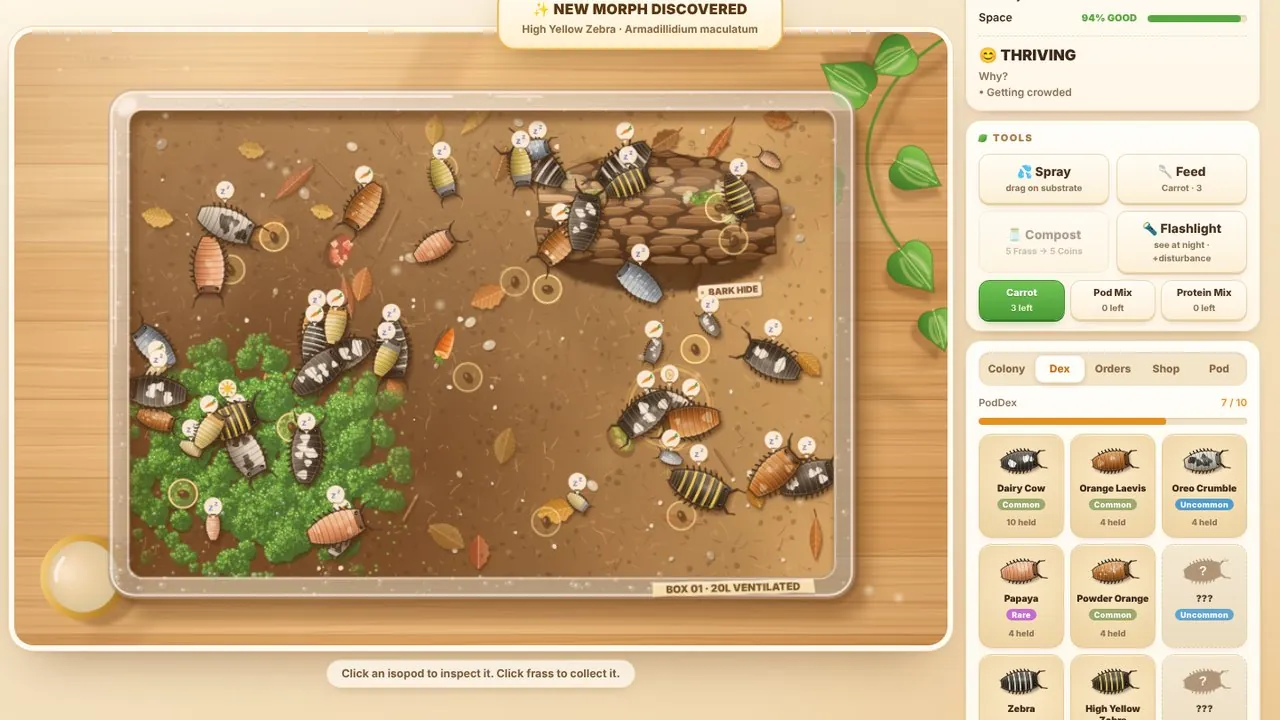
| Species | Morph | Rarity | Genes it needs | Shop price | Base sell |
|---|---|---|---|---|---|
| Porcellio laevis | Dairy Cow | Common | normal colour + normal surface | 12 | 8 |
| Porcellio laevis | Orange Laevis | Common | oo + normal surface | 34 | 22 |
| Porcellio laevis | Oreo Crumble | Uncommon | normal colour + ww | 78 | 46 |
| Porcellio laevis | Papaya | Rare | oo + ww | 210 | 120 |
| Porcellionides pruinosus | Powder Orange | Common | normal colour | 44 | 26 |
| Porcellionides pruinosus | Powder Blue | Uncommon | oo | 110 | 64 |
| Armadillidium maculatum | Zebra | Uncommon | normal surface | 145 | 80 |
| Armadillidium maculatum | High Yellow Zebra | Rare | ww | 340 | 190 |
| Cubaris sp. | Rubber Ducky | Legendary | normal colour | 980 | 520 |
| Cubaris sp. | Blonde Rubber Ducky | Legendary | oo | never sold | 900 |
Only Porcellio laevis uses both genes, so it has four morphs. The other three species use one gene each, so they have two. The shop sells the starter morph of every species you have unlocked. Any other morph appears in the shop only after you have bred or discovered it yourself. Blonde Rubber Ducky is never sold, so it can only be bred.
Daisy's secret
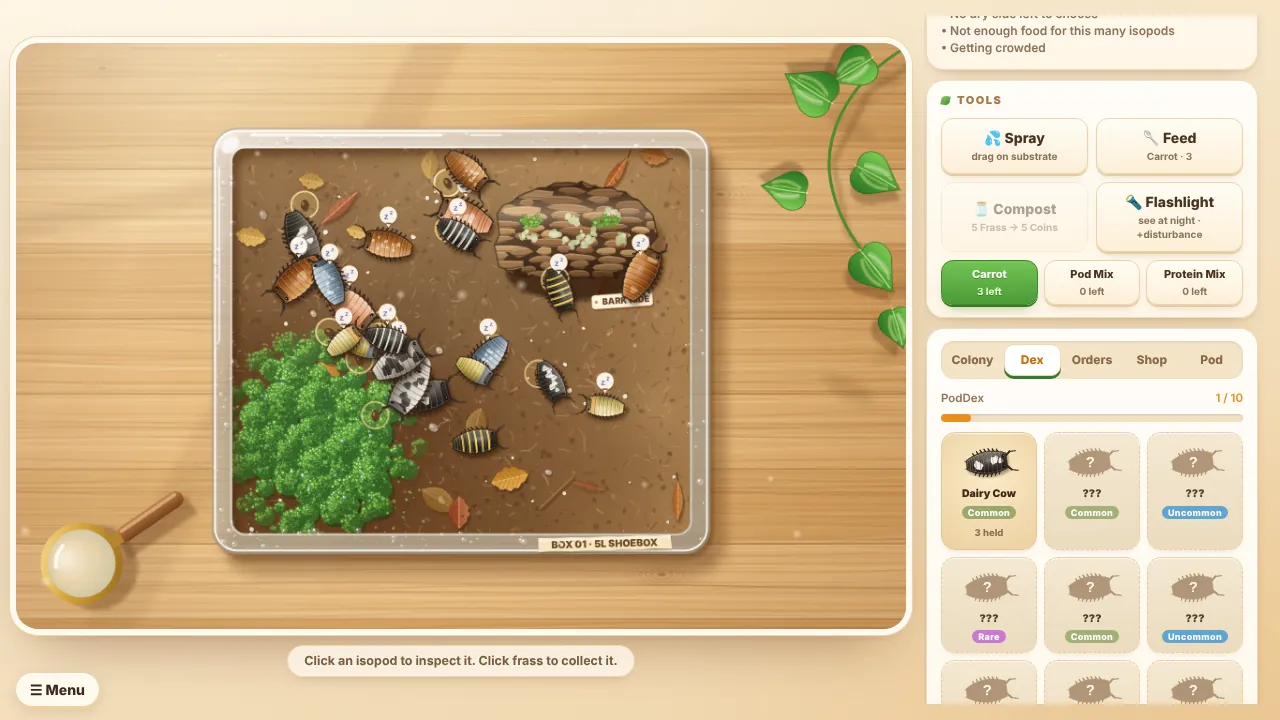
Daisy, the Dairy Cow you start with, carries both hidden copies: one colour copy and one surface copy. The game never tells you. That means every laevis morph (Orange Laevis, Oreo Crumble and Papaya) can come out of her line.
Isopods from the shop each have a 45% chance per gene to carry a hidden copy that their own morph doesn't show. So your first bought male may or may not be a carrier. Here is what Daisy's first broods can look like:
| Daisy paired with | Babies you can expect |
|---|---|
| A male carrying nothing | All Dairy Cows. Each baby has a 50% chance to carry each of Daisy's hidden copies |
| A male carrying the colour copy | About 1 in 4 Orange Laevis |
| A male carrying the surface copy | About 1 in 4 Oreo Crumble |
| A male carrying both | About 9 Dairy, 3 Orange, 3 Oreo, 1 Papaya in every 16 |
Test pairings: finding carriers
Once you own one isopod that shows a colour, you can test any normal-looking isopod of the same species. Pair the unknown one with the coloured one. If even one baby shows the colour, the unknown parent is a carrier. If a whole litter of six comes out normal, it almost certainly is not (a carrier would give six normal babies only about 1 time in 64).
- To test for the colour copy in laevis, pair with an Orange Laevis.
- To test for the surface copy in laevis, pair with an Oreo Crumble.
- For Powder Orange, test with a Powder Blue. For Zebra, test with a High Yellow Zebra.
- Keep the carriers you find. Sell or give away the rest through orders.
A step-by-step plan for Papaya
- 1
Get colour and surface
Breed Daisy's line until you have an Orange Laevis and an Oreo Crumble.
- 2
Make double carriers
Pair Orange × Oreo. Every baby carries both copies, and most look like plain Dairy Cows.
- 3
Pair two of those
Two double carriers give about 1 Papaya in 16, plus more Orange and Oreo.
- 4
Shortcut with carriers
An Orange that carries the surface copy × an Oreo that carries the colour copy gives 1 Papaya in 4.
- 5
Lock it in
Papaya × Papaya always gives Papaya. Once you have a pair, every brood is the colour you want.
The same rule holds for every morph that needs two hidden copies. Two Orange Laevis always give Orange (or Papaya, if both carry the surface copy). Two Powder Blues always give Powder Blue. Two High Yellow Zebras always give High Yellow Zebras.
Species: growth and brood size
| Species | Keeper Level | Adult at | Brood takes | Brood size |
|---|---|---|---|---|
| Porcellio laevis | 1 | day 18 | 5 days | up to 8 |
| Porcellionides pruinosus | 3 | about day 14 | 4 days | up to 7 |
| Armadillidium maculatum | 6 | about day 29 | about 8 days | up to 5 |
| Cubaris sp. | 11 | day 45 | 12.5 days | 1 to 3 |
Pruinosus is quick and moves fast. Maculatum grows slowly and drops a little more frass. Cubaris is the slowest by far: it needs the most water and has the smallest broods, so the Rubber Ducky line takes patience. Bought Rubber Duckies have the same 45% chance to carry the colour copy, so two bought carriers give a Blonde Rubber Ducky about 1 time in 4.
Success chance, litter size and markings
- Success chance depends on the parents' stage and on the care score. Two adults in a thriving box are close to a sure thing. Two subadults in the same box land about two times in three. Protein Mix in the tub adds 12%.
- A failed pairing only costs the female 2 days of rest. After a real brood the mother rests 9 days. Males don't need to rest, so one good male can pair with several females in a row.
- Litter size grows with the care score, and an adult mother has bigger broods than a subadult.
- Markings are separate from colour. Each baby's number and size of spots (or stripes) is the average of its parents, nudged a little. About 1 baby in 50 gets a bigger random change.
- Bold markings pay. A heavily marked adult sells for up to 1.2 × the base price, and a lightly marked one for as little as 0.72 ×.
Each morph you see for the first time fills a PodDex card and pays Keeper XP: 60 for a Common, 80 for an Uncommon, 100 for a Rare and 140 for a Legendary. New morphs are one of the fastest ways to level up. More on that in orders and upgrades.
Can I breed two different species together in Pod Box?
No. The pairing screen blocks it with "Species incompatible". Every morph comes from its own species.
How do I get a Papaya isopod?
Papaya needs two colour copies and two surface copies. Breed Orange Laevis and Oreo Crumble, pair their double-carrier babies, and keep any Papaya pair you get.
Can I see an isopod's genes?
No. Profiles show genetics as unknown. Test pairings with a coloured isopod tell you who is a carrier.
Is Blonde Rubber Ducky in the shop?
Never. It is the only morph you can only get by breeding two Rubber Ducky carriers.
Should I use auto-breeding for colours?
Turn it off for colour projects. It pairs a random female with the nearest male, so you can't plan which genes meet.
Ready?
Put it into practice
Raise a colony of tiny isopods and breed new colours.